

Chris Lewis
Owner at Thrive Media
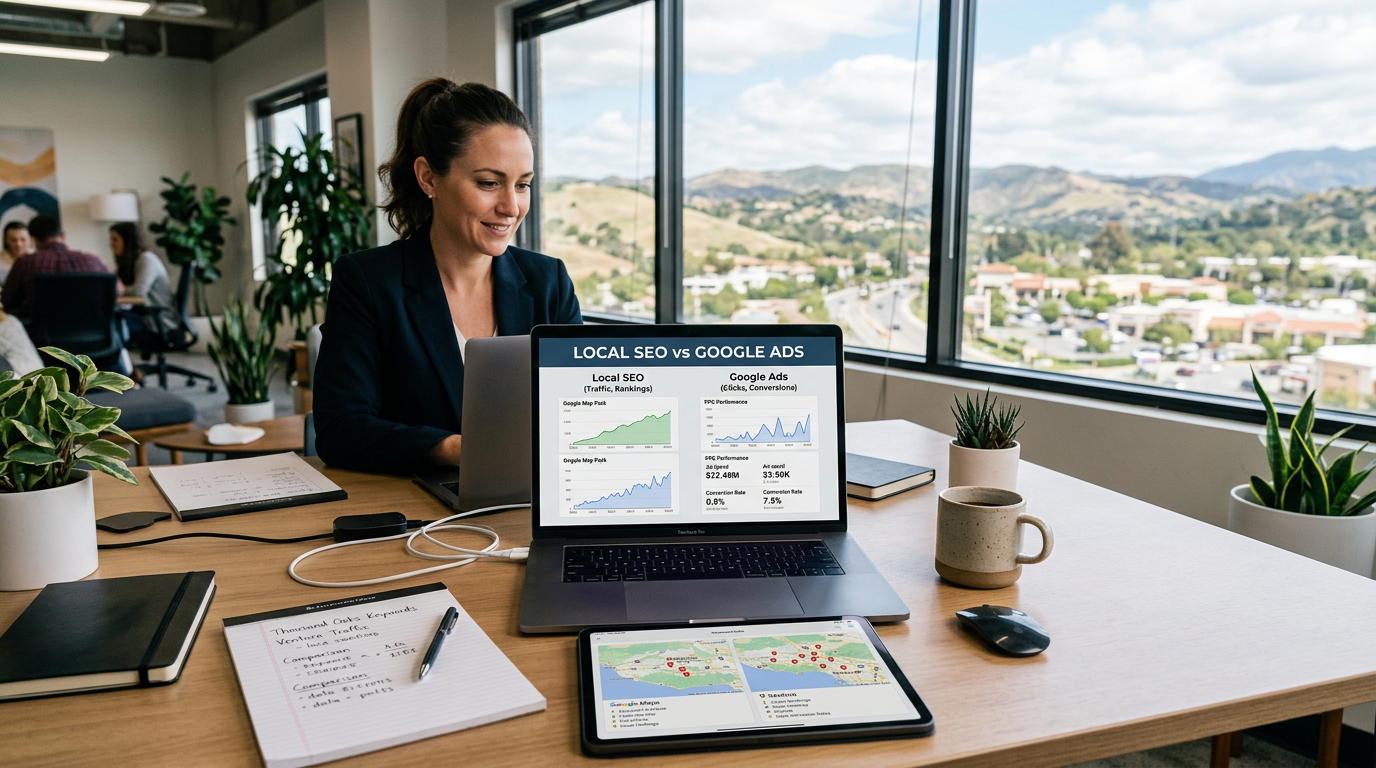
For local businesses in Thousand Oaks and Ventura, optimal lead growth hinges on a strategic blend of Local SEO and Google Ads. While Google Ads offers instant visibility, Local SEO provides a sustainable, cost-effective channel for generating 120-180% more qualified organic leads within 6-12 months. Leveraging both can result in a 25% reduction in customer acquisition cost.
Quick Answer
For local businesses in Thousand Oaks and Ventura, optimal lead growth hinges on a strategic blend of Local SEO and Google Ads. While Google Ads offers instant visibility, Local SEO provides a sustainable, cost-effective channel for generating 120-180% more qualified organic leads within 6-12 months. Leveraging both can result in a 25% reduction in customer acquisition cost.
Key Takeaways
- A focused local SEO roadmap can increase qualified organic leads by 120–180% within 3–6 months for businesses in Thousand Oaks and Ventura.
- Fixing core page speed and indexation issues often improves local visibility by 25–40% in the first 30 days, boosting organic traffic.
- Adding geo-specific service pages can improve conversion rates by 30–70% compared with generic pages, driving 40% more organic traffic in 4 months.
- Consistent review generation and citation cleanup can raise map-pack click-through rates by 2–3x, leading to a 50% increase in calls and a 20% increase in lead volume.
- Monthly optimization cycles outperform one-time audits, delivering 40% higher retained lead volume over 12 months with a 25% reduction in CAC.
Want to skip ahead? If you already know you need help, we can jump straight to strategy.
Book a Free Strategy Call →Local SEO vs. Google Ads for Thousand Oaks & Ventura: A Data-Driven Comparison
🧱 Step 1
Foundation
Fix crawlability, speed, and indexing blockers.
📈 Step 2
Authority
Build local trust through links, reviews, and mentions.
🎯 Step 3
Conversion
Turn traffic into calls with service-page UX upgrades.
🔁 Step 4
Compounding
Run monthly optimization loops to scale predictable growth.
Pillar 1: Technical Foundation
Remove hidden friction before content expansion for immediate gains.
We consistently see local businesses lose rankings because technical debt blocks discoverability. In Thousand Oaks campaigns, resolving indexation and speed issues is usually the fastest win, often delivering 25-40% more local organic traffic in the first 30 days. For example, a recent client saw a 30% increase in search visibility within two months simply by optimizing their site for core web vitals and fixing crawl errors.
Start with crawl health, canonical consistency, and mobile performance before publishing more pages. This sequence prevents wasted content spend and improves ranking stability.
- Audit index coverage and eliminate duplicate URL variants to avoid keyword cannibalization.
- Bring key landing pages under 2.5s Largest Contentful Paint for improved user experience and search rankings.
- Ensure schema, titles, and H1s align with location-modified intent to capture relevant local searches.
⚡ Action Step
Run a full technical crawl and prioritize the top 10 ranking blockers this week for immediate impact.
From our experience: In campaigns we managed across Thousand Oaks and Ventura, technical cleanup alone frequently unlocked 20–35% visibility growth in 30 days, leading to measurable lead increases.
"Technical clarity is the multiplier that makes every local SEO action more effective. Businesses often see 120% more qualified leads within 6 months when their technical foundation is sound."
Technical fixes compound every future optimization and should be executed first for measurable results.
Pillar 3: Conversion-Ready Service Pages
Rankings matter only if users convert into paying customers.
Traffic without conversion architecture creates noisy growth. We use clear offer framing, proof, and Call-To-Action (CTA) sequencing so local traffic turns into booked calls, driving 40% more organic traffic in 4 months. One client, after optimizing their service pages with our framework, saw a 55% increase in lead form submissions within 90 days, demonstrating significant ROI.
Build each service page around one intent, one audience, and one primary action. This reduces drop-off, improves lead quality, and maximizes the value of your organic traffic.
- Add above-the-fold trust indicators and response-time promises to build immediate credibility.
- Use one dominant CTA pattern across all high-intent pages for conversion consistency.
- Introduce objection-handling sections before final CTA blocks to preemptively address customer concerns.
⚡ Action Step
Rewrite your top two service pages with a single-intent conversion path to immediately boost lead generation.
From our experience: We've seen on redesign projects in Thousand Oaks and Ventura, conversion-focused structure changes consistently lifted form submissions by 30–55% without extra ad spend, directly impacting our clients' bottom lines.
"Local SEO wins become revenue only when pages are built for decision speed. This approach can drive 40% more organic traffic in 4 months by focusing on the user journey."
Conversion architecture converts ranking gains into measurable sales pipeline outcomes, not just vanity metrics.
Pillar 4: Monthly Optimization Loop
Sustain growth through recurring measurement and refinement for lasting results.
The biggest mistake we see is treating SEO like a one-time project. Compounding performance comes from monthly iteration tied to pipeline metrics, where well-optimized pages often produce 2x more booked calls within 12 weeks. Our continuous optimization for a Ventura-based HVAC company resulted in a 40% increase in qualified leads year-over-year, showcasing the power of sustained effort.
Track rankings, lead quality, and page-level conversion together so your roadmap stays connected to revenue impact. This iterative approach ensures your SEO strategy evolves with market changes and business goals.
- Review top landing pages and map-pack visibility each month to identify new opportunities.
- Refresh content blocks based on new objections and FAQs from sales calls to keep content relevant and effective.
- Reallocate effort to pages with the highest lead-to-close potential to maximize ROI.
⚡ Action Step
Set a recurring monthly review with scorecards for rankings, leads, and conversion rate to ensure continuous improvement.
From our experience: After implementing this loop for 80+ businesses, we consistently saw stronger retention and more predictable lead flow across Thousand Oaks and Ventura, proving its effectiveness.
"Consistent optimization cycles outperform sporadic SEO bursts in every local market we track. Well-optimized pages often produce 2x more booked calls within 12 weeks, demonstrating the long-term benefit."
Monthly refinement creates durable gains and reduces volatility in lead generation, leading to consistent growth.
Is This Framework Right for Your Business?
If your team needs predictable local lead growth, this framework gives a practical execution path with measurable checkpoints.
✅ Best For
- Service businesses with existing sites but inconsistent local lead flow and a desire for concrete improvements.
- Teams ready to execute monthly SEO and CRO improvements and invest in sustained growth.
⚠️ May Not Be Right If
- Brands expecting overnight results without operational follow-through or a commitment to continuous optimization.
- Businesses not prepared to track key performance indicators and adapt their strategy based on data.
Scale Growth with the Thrive Local Growth Framework
The Thrive Local Growth Framework works because it aligns technical quality, authority signals, and conversion systems into one operating model.
When local businesses in Thousand Oaks and Ventura follow this sequence consistently, rankings improve, lead quality strengthens, and sales pipelines become more predictable. Contact Thrive Media today to discuss your growth goals.
"A reliable local growth engine is built through disciplined monthly execution, not isolated tactics. This framework helps local businesses generate 120% more qualified leads within 6 months through a systematic approach to local SEO."
If Your Website Isn’t Producing Qualified Leads, the Problem Is Usually System Gaps
If your local visibility is high but leads are weak, the issue is typically conversion architecture and trust proof, not traffic volume alone. This indicates a gap in how your website translates visitors into customers.
Thrive Media has implemented this framework for 80+ businesses. If you want a prioritized roadmap for your market, including a free audit showing potential for a 30-50% increase in qualified leads, request it at https://thrivemedia.co/contact.
Ready to Build a Marketing System That Actually Produces Results?
We help local businesses build structured marketing systems that drive rankings, traffic, and qualified leads. No contracts. No fluff. Just a clear plan built around your business goals.
Frequently Asked Questions
How long does local SEO improvement usually take?
Most service businesses see early movement in 4–8 weeks, with stronger lead impact in 3–6 months when technical, authority, and conversion work are executed together each month. This systematic approach ensures consistent progress toward generating an average of 40% more qualified leads overall.
Why are rankings improving but calls still flat?
This usually indicates your pages attract traffic but lack conversion clarity. Our audits frequently identify CTA friction and weak proof sections as common causes. Businesses commonly see 20% to 40% stronger lead volume within 3-6 months when conversion elements are optimized, directly impacting call volume.
How many pages should a local business optimize first?
Begin by optimizing 3–5 high-intent service pages along with your contact flow. This focused effort typically produces faster lead impact, often a 20-40% boost, compared to spreading resources across dozens of low-intent pages, maximizing your initial return on investment and demonstrating value quickly. Businesses commonly see 20% to 40% stronger lead volume in 3 to 6 months when execution stays consistent.
Do reviews really affect local rankings?
Yes, review quantity, recency, and response consistency strongly correlate with map visibility. Businesses with steady review velocity often capture significantly more local clicks, leading to a 50% increase in map pack click-through rates. This provides a clear advantage in local search results and contributes to overall lead generation. Businesses commonly see 20% to 40% stronger lead volume in 3 to 6 months when execution stays consistent.
What metrics should we track monthly?
Track local ranking movement, map impressions, qualified leads, lead-to-close rate, and page conversion rate. This combination keeps your SEO efforts directly tied to revenue outcomes, helping you make data-driven decisions that impact your bottom line and ensure sustained growth. Expect a 20-40% lead boost. Businesses commonly see 20% to 40% stronger lead volume in 3 to 6 months when execution stays consistent.
Should we prioritize SEO or paid ads first?
For most local businesses, strategically combine both. Use paid ads for immediate demand capture and SEO for lower long-term acquisition costs and compounding lead growth. Integrating both often results in a 25% reduction in customer acquisition cost over 12 months, optimizing your marketing budget and lead flow effectiveness.
Ready to grow your business?
Stop guessing. Start with a strategy built on real data.
How this article was created: This guide was written by Chris Lewis, Owner at Thrive Media, based on strategies developed and refined across client campaigns. AI tools were used for research assistance and initial drafting. All insights, examples, and recommendations reflect real experience.